OpenScout V1.2 (Group Project)
My role on this project: Robotics / Embedded Systems Engineer
Project Overview
An open-source mobile robot platform bridging embedded systems with modern robotics middleware. The platform supports three simultaneous control modes without mode switching: HC-12 long-range wireless, USB serial, and ROS 2 over WiFi via a lightweight TCP/JSON bridge.
ArduinoC++ROS2 HumbleFreeRTOSPythonDockerHC-12L298NFreeCAD3D Printing
Project Link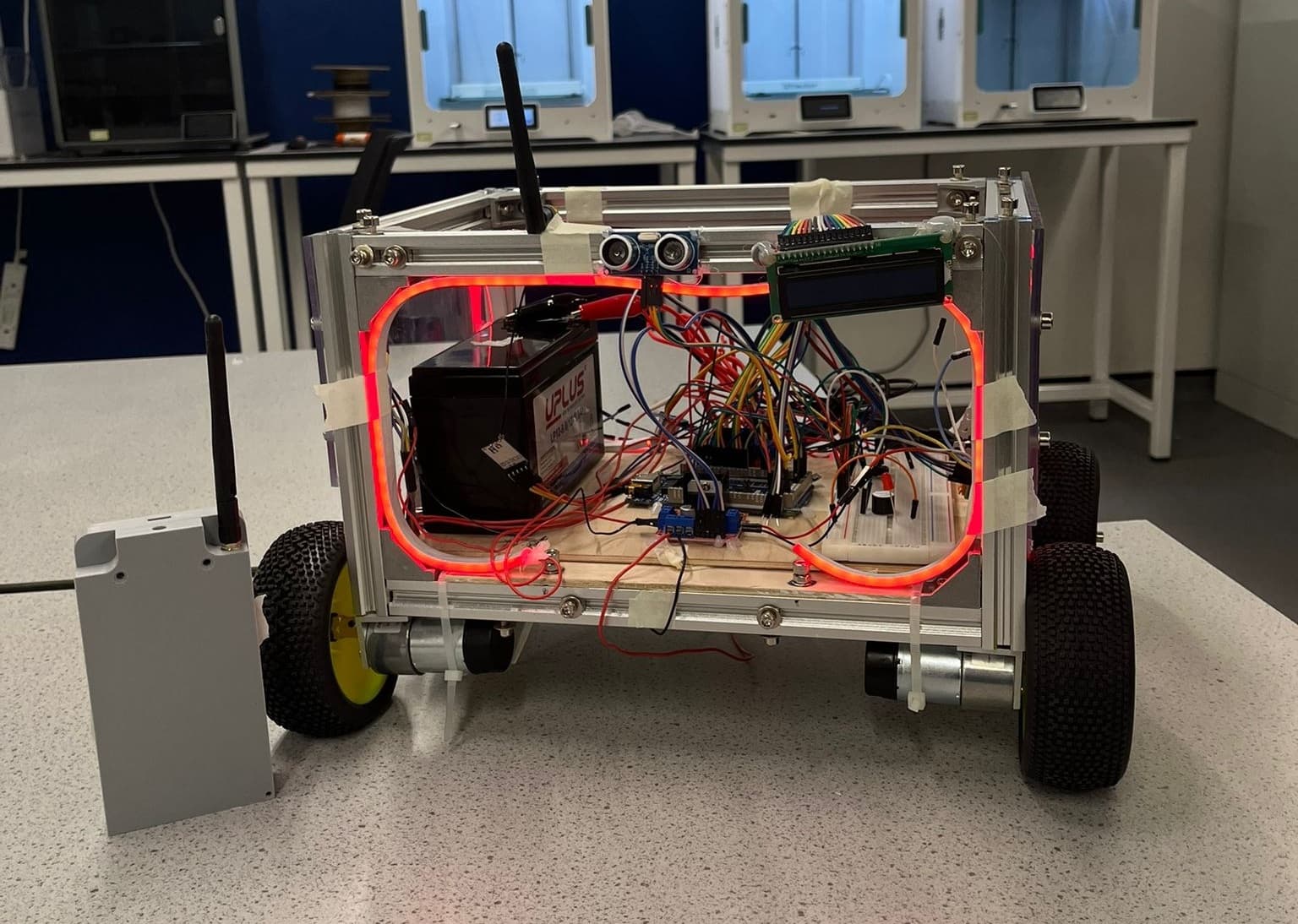
Showcase Video
Achievements
- Implemented a lightweight TCP/JSON bridge on the Arduino GIGA R1 WiFi enabling ROS 2 Twist message compatibility without Micro-ROS or rosserial
- Deployed a Dockerized Python ROS 2 bridge that subscribes to Twist messages, converts them to JSON, and streams commands to the robot over TCP
- Implemented FreeRTOS-based concurrent task management with dedicated tasks for motor control, WiFi, TCP server, HC-12, and serial communication
- Designed task priority structure ensuring motor control preempts all other tasks for safe and deterministic operation
- Implemented HC-12 wireless communication over 433MHz serial between Arduino Uno transmitter and GIGA receiver, achieving approximately 100m range in open space
- Designed and 3D printed a custom remote control enclosure housing the Arduino Uno, HC-12 module, 4x4 keypad, and emergency stop membrane switch
- Emergency stop response time measured at mean 12ms from switch press to full motor shutdown
- Implemented last-command-wins arbitration across all three control interfaces enabling seamless override and smooth handover without mode switching
- Validated seamless control transitions with delays not exceeding 20ms across HC-12, USB serial, and ROS 2 interfaces
- Integrated four HC-SR04 ultrasonic sensors with automatic collision prevention, achieving 100% detection rate for large objects and 94% for medium objects
- Safety interlock average reaction time of 185ms with zero false positives across 200 stationary trials
- Supported chassis assembly using 20x20 aluminium extrusion with angle brackets and cast corner connectors
- Assisted with electrical wiring including dual L298N motor drivers, ultrasonic sensors, buzzer, and LED strip controlled via MOSFETs
- Implemented differential drive kinematics mapping ROS 2 linear and angular velocity to individual wheel PWM commands, shared across all control interfaces